Well Come To Nature

Thursday, 8 September 2011

SNOW FOX

The arctic fox lives in some of the most frigid extremes on the planet. Among its adaptations for cold survival are its deep, thick fur, a system of countercurrent heat exchange in the circulation of paws to retain core temperature, and a good supply of body fat. The fox has a low surface area to volume ratio, as evidenced by its generally rounded body shape, short muzzle and legs, and short, thick ears. Since less of its surface area is exposed to the arctic cold, less heat escapes the body. Its furry paws allow it to walk on ice in search of food. The arctic fox has such keen hearing that it can precisely locate the position of prey under the snow. When it finds prey, it pounces and punches through the snow to catch its victim. Its fur changes colour with the seasons: in the winter it is white to blend in with snow, while in the summer months it changes to brown.


Reproduction:-
The arctic fox tends to be active from early September to early May. The gestation period is 53 days. Litters tend to average 5-8 kits but may be as many as 25. Both the mother and the father help to raise their young. The females leave the family and form their own groups and the males stay with the family.Foxes tend to form monogamous pairs in the breeding season. Litters are born in the early summer and the parents raise the young in a large den. Dens can be complex underground networks, housing many generations of foxes. Young from a previous year's litter may stay with the parents to help rear younger siblings.The kits are initially brownish; as they become older they turn white. Their coat of fur also changes color when summer arrives but in winter it is white.

Diet:-
The arctic fox will generally eat any small animal it can find: lemmings, hares, owls, eggs, and carrion, etc. Lemmings are the most common prey. A family of foxes can eat dozens of lemmings each day. During April and May the arctic fox also preys on ringed seal pups when the young animals are confined to a snow den and are relatively helpless. Fish beneath the ice are also part of its diet. If there is an overabundance of food hunted, the arctic fox will bury what the family cannot eat. When its normal prey is scarce, the arctic fox scavenges the leftovers and even feces of larger predators, such as the polar bear, even though the bear's prey includes the arctic fox itself.

Size:-
The average length is 85.3 cm (33.6 in), with a range of 83 to 110 cm (33 to 43 in), in the male and 82.1 cm (32.3 in), with a range of 71.3 to 85 cm (28.1 to 33 in), in the female. The tail is 31 cm (12.2 in) long in the male and 30 cm (11.8 in) long in the female. It is 25–30 cm (9.8–11.8 in) high at the shoulder.On average males weigh 3.5 kg (7.7 lb), with a range of 3.2 to 9.4 kg (7.1 to 21 lb), while females average 2.9 kg (6.4 lb), with a range of 1.4 to 3.2 kg (3.1 to 7.1 lb).


White Ermine


Geographic Range


Ermine have a circumpolar distribution. They are found in the north temperate regions of Eurasia and North America. In the New World, they range from east to west in a broad belt from the Arctic Ocean and adjacent islands of the Canadian Archipelago southward into the northern United States. Ermine are absent from the Great Plains. 


Habitat
Ermine prefer riparian woodlands, marshes, shrubby fencerows, and open areas adjacent to forests or shrub borders. Although ermine are primarily terrestrial, they climb trees and swim well. Tree roots, hollow logs, stone walls, and rodent burrows are used as dens. Dens are usually around 300mm below ground. Ermine line their nests with dry vegetation, and fur and feathers from prey. Side cavities of burrows are used as food caches and latrines. (Ruff and Wilson, 1999)


Physical Description
Mass: 25 to 116 g (0.88 to 4.08 oz)
Length: 170 to 330 mm (6.69 to 12.99 in)
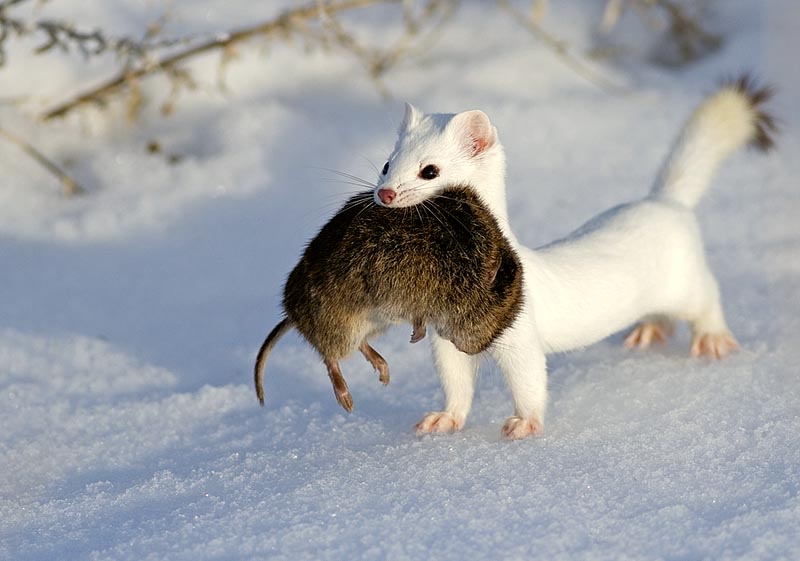
At full adult size total body length from head to rump is 170mm to 330mm. Males are generally twice as large as females, with males weighing from 67 to 116 grams and females from 25 to 80 grams. The tail length is about 35% of the total body length, ranging from 42mm to 120mm. Ermine have the typical weasel form: long body, short legs, long neck supporting a triangular head, slightly protruding round ears, bright black eyes, and long whiskers. Their short, moderately fine fur is white in the winter and the tip of the tail is black. In the summer, the dorsal fur is chocolate brown while the ventral fur extending to the upper lip is yellowish white.


Reproduction
Breeding interval: Ermine generally breed once yearly.
Breeding season: Ermine mate in late spring to early summer.
Number of offspring: 3 to 18; avg. 4-9
Gestation period: 280 days (average)
Time to weaning: 8-10 weeks (average)
Age at sexual or reproductive maturity (female): 60-70 days (average)
Age at sexual or reproductive maturity (male): 2 years (average)
Ermine are a polygynous-promiscuous species, with males and females mating opportunistically.
Ermine mate in late spring to early summer. Females are polyestrous, but produce only 1 litter per year. Young are born in April or May after an average gestation period of 280 days, which includes an 8-9 month period of developmental delay. Longer days beginning in March trigger the resumption of fetal development. Litter size ranges from 3-18 offspring and averages 4-9. The sex ratio is unequal. Young are blind and helpless. They are covered with fine white hair, and a prominent dark mane of dense fur develops around the neck by the third week (function unknown). The young grow quickly and are able to hunt with their mother by their eighth week. Although females do not reach adult size until a least 6 weeks after birth, they are able to mate when they are 60-70 days old, often before they are weaned. Males do not breed or gain adult dimensions until their second summer.
Females exclusively care for their offspring, nursing and protecting them until they become independent. The young are born blind and helpless.Females in nature may survive for at least 2 breeding seasons, while males generally do not survive this long. Reproductive success is highly dependent on food availability.

Lifespan/Longevity
Longest known lifespan in wild
7 years (high)
Expected lifespan in wild
1-2 years (average)

Behavior
The ermine's lithe, agile body allows it to move swiftly both above ground and through underground burrows. Females hunt in tunnels more than males, which may explain the higher number of males that are trapped. Ermine can also run easily across snow. This ideal predator hunts in a zigzag pattern, progressing by a series of leaps of up to 50 cm each. Ermine investigate every hole and crevice, often stopping to survey their surroundings by raising their heads and standing upright on their hindlegs. They may travel up to 15 km in one night.
Adult males dominate females and young. Females tend to remain in their birth place throughout their lives. Males disperse and attain large territories that usually encompass or overlap females' territories.
Male and female ermine only associate with one another during the breeding season.

Home Range
Ermine population densities fluctuate with prey abundance. When conditions are good, an individual may occupy a 10ha area. The maximum home range size is about 20ha. Home ranges of males are usually twice the size of female home ranges. These solitary mammals maintain exclusive boundaries that are patrolled and marked by scent. (Ruff and Wilson, 1999)

Communication and Perception
Ermine have keen senses of smell, vision, hearing, and touch that help them to locate prey. Most mustelids are fairly quiet animals, but some vocalizations may be used in intra-specific communication. Chemical cues are probably the main means of communication reproductive readiness to potential mates.

Food Habits
Ermine are carnivores that hunt primarily at night. They are specialist predators on small, warm-blooded vertebrates, preferably mammals of rabbit size and smaller. When mammalian prey is scarce, ermine eat birds, eggs, frogs, fish, and insects. In severe climates, ermine frequently hunt under snow and survive entirely on small rodents and lemmings. Daily meals are essential to meet the ermine's exhorbitant energy and heat production demands. Ermine cache leftover meals as a way of dealing with these demands. (Ruff and Wilson, 1999)
Once a potential prey is identified, the ermine approaches as closely as possible. With incredible speed it grasps the back of the victim's head and neck with sharp teeth, and wraps its body and feet around the victim. The victim dies from repeated bites to the base of the skull. Ermine have keen senses that help them locate prey. Hares and rodents are mainly followed by scent, insects by sound, and fish by sight. (Ruff and Wilson, 1999)

Predation
Ermine are fierce and agressive, although diminutive, animals. Potential predators are larger carnivores including red fox, gray fox, martens, fishers, badgers, raptors, and occassionally domestic cats. 

Wolves

Type:Mammal
Diet:Carnivore
Average life span in the wild:6 to 8 years
Size:Head and body, 36 to 63 in (91 to 160 cm); Tail, 13 to 20 in (33 to 51 cm)
Weight:40 to 175 lbs (18 to 79 kg)
Group name:Pack
Protection status:Endangered
Size relative to a 6-ft (2-m) man


here are lots of different types of wolves. There are artic wolves, gray wolves, red wolves, Mexican wolves, Persian wolves, Indian wolves and Chinese wolves. On our website, we talk about the timber wolf, also known as the gray wolf. Gray wolves live in the Artic, Yellowstone National Park, Wyoming, Minnesota, Idaho, Montana and Europe.Wolves are carnivores that live in the more wild parts of the world. They are great and majestic animals. They have been around for centuries and centuries. Wolves are very intelligent. They have a keen sense of smell and hearing. They know how to hunt together, bring down large prey, play to sharpen their hunting strategies, establish their own hierarchy, and many other things. Wolves are the great ancestors of the very animals many of you have at home, dogs. Dogs and wolves genetically diverged 135,00 years ago. Some dogs look like wolves, and some look nothing like them!
Wolves function as social predators and hunt in packs organised according to a strict social hierarchy and led by an alpha male and alpha female. This social structure allows the wolf to take prey many times its size. The size of the pack changes during the year and is controlled by factors such as mortality and food supply. Generally it's between 2 and 12, even if packs with more than 30 has been recorded. The hierarchy of the pack is strict, with the alpha on top and the omega at the bottom. The hierarchy controls all activity in the pack, from which wolf eats first to who is allowed to breed (generally only the alpha pair). Between the extremes of the alpha and the omega there is generally a beta pair, contesters for the alpha position that will take it if any of the alpha wolves are killed. Also, depending on the season there might be a number of pups and yearlings.
New packs are formed when a wolf leaves its birth pack and claims a territory. Wolves searching for other wolves to form packs with or suitable territories can travel very long distances. Packs frequently break apart when the alpha pair is killed.
Hunting:-
The wolf is somewhat opportunistic and will eat what it comes across as long as it is reasonably fresh. Packs of wolves hunt any large herbivore in their range, while lone wolves are more prone to take eat anything the come across, including rodents. The hunting methods ranges from surprise attacks on smaller animals such as rabbits and rodents to long lasting chases. Wolves can chase large prey for several hours before giving up, but the success rate is rather low.

Monday, 1 August 2011

Platypus Neither birds nor mammals

It lays eggs. This is usually reserved exclusively for birds, reptiles, dinosaurs, etc. And these eggs are tiny! Mammals gestate with the eggs inside of them, giving birth to live young, but here’s a mammal that lays eggs! 

It’s furry. Like mammals are — no feathers for this guy — the platypus is not only covered in fur, it’s got such a nice coat that it has historically been hunted for its fur! 

It is venomous! This is extremely rare for mammals, and the platypus itself has three venomous compounds in it that are unique in all of nature to the platypus itself. The venom is emitted through a spur in the platypus’ foot, right around its ankle. And speaking of feet… 

It has a beaver-like tail. Mammalian, I got it. I suppose we can go on and on, listing all the ways this animal is neither bird nor mammal, all of which I find fascinating. But this animal can do something that you and I cannot, no matter how hard we try. Your skin, your epidermal layer, is fantastic for sensing temperature, pressure, and pain. These three types of sensor suit us remarkably well, and allow us to experience all sorts of interesting sensations, like itch and ticklishness. But the platypus has us beat, because in addition to these, the platypus can detect electricity.